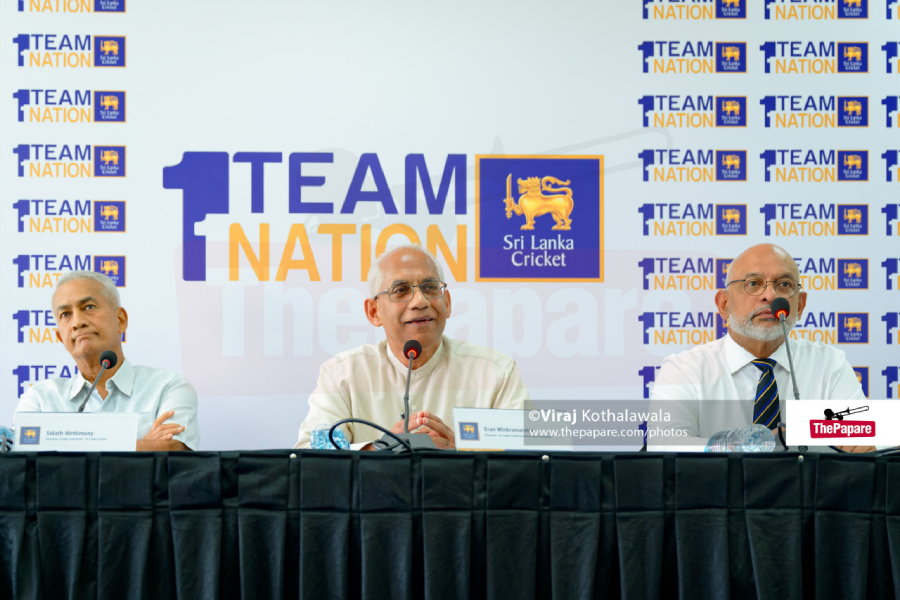
This week felt like Sri Lankan cricket had finally begun to emerge from a long spell of batting on a sticky wicket. After years of stagnation, confusion and underachievement, the sport appeared to take a few much-needed strides towards reform and renewal.
There is little doubt that cricket in the island had gone stale in recent years, something reflected not only in results on the field but also in the growing frustration among supporters. A change of guard and fresh thinking were badly needed and, for the first time in a while, there seems genuine reason for optimism.
Head of the Cricket Committee Sidath Wettimuny did not walk in promising dramatic overhauls, flashy slogans or imported quick-fix solutions. There was no talk of tearing down the existing structure overnight or parachuting in a foreign Cricket Director with a fancy resume. Instead, Sidath focused on the finer details, the nuts and bolts of the game that often go unnoticed but ultimately decide whether a cricket system flourishes or crumbles.
One of the key points he highlighted was how cricket exploded in popularity after the 1996 World Cup triumph. Schools playing the sport mushroomed overnight as every parent wanted their son to become the next Aravinda de Silva or Sanath Jayasuriya. But while the demand grew rapidly, the establishment failed to keep pace. The supply chain of quality coaches remained painfully inadequate and Sidath stressed that addressing this shortcoming would become a major priority.
Improving the standard of coaching at school level appears high on the agenda of the Cricket Committee, which also includes former captain Roshan Mahanama and Kumar Sangakkara. Sangakkara, despite his international commitments, has reportedly been joining discussions remotely, lending both weight and wisdom to the process.
Too often these days when you walk into an Under-15 fixture, you see school coaches behaving like puppet masters. Some stand near the boundary rope barking instructions ball after ball while others practically captain the side from outside the field. Cricket, however, is a game that develops thinkers and decision makers. Captains must learn to read situations, trust their instincts and make calls under pressure. Otherwise, the system will never produce another Mahela Jayawardene, a captain whose cricket brain was often three steps ahead of the opposition.
As a first step, National Head Coach Gary Kirsten is set to address school coaches and there are plans to introduce educational programmes aimed at improving the knowledge and methods of coaches involved in school cricket. At a time when everyone is obsessed with fixing players, Sri Lanka Cricket’s initiative to improve the quality of coaches deserves applause. After all, better coaches invariably produce better cricketers.
Another issue Sidath touched on was the need to regulate cricket academies. These days, every Tom, Dick and Harry seems to be opening an academy in pursuit of a quick buck. While there are several academies run by respected coaches that genuinely help nurture young talent, there are also many that contribute very little to player development. Monitoring and regulating these institutions is therefore a timely and necessary step.
Sidath also acknowledged the sad state of Sri Lanka’s Test cricket and admitted that the country had slipped alarmingly behind the leading nations in the longest format. He promised that measures would be taken to provide the Test side with more opportunities, even if it meant arranging games outside the framework of the World Test Championship.
Following Sidath at the media briefing was never going to be easy. Articulate, intelligent and deeply knowledgeable about the game, he set a high bar. Yet Chairman Eran Wickramaratne held his own impressively as he explained the reasons behind cricket’s decline in recent years.
While acknowledging that Sri Lanka Cricket’s election process is democratic in principle, Eran pointed out that the existing system is riddled with loopholes. In his view, only constitutional reform can truly put the game back on the right track. He explained that views and proposals would be sought from all stakeholders; players, coaches, umpires, member clubs and even the general public, before legal experts draft a new constitution. Those wishing to challenge the proposals would still have the opportunity to seek legal recourse through the courts. Once all hurdles are cleared, the constitution will be tabled in Parliament and once approved, Sri Lanka Cricket could finally begin operating on firmer footing.
True, Sri Lankan cricket remains some distance from where it wants to be. Years of neglect cannot be erased overnight. But as the old saying goes, well begun is half done. The new committee has spoken a great deal of sense in its opening exchanges and for the first time in a long while, those who love the game dare to hope that Sri Lanka may yet become a force to reckon with again.