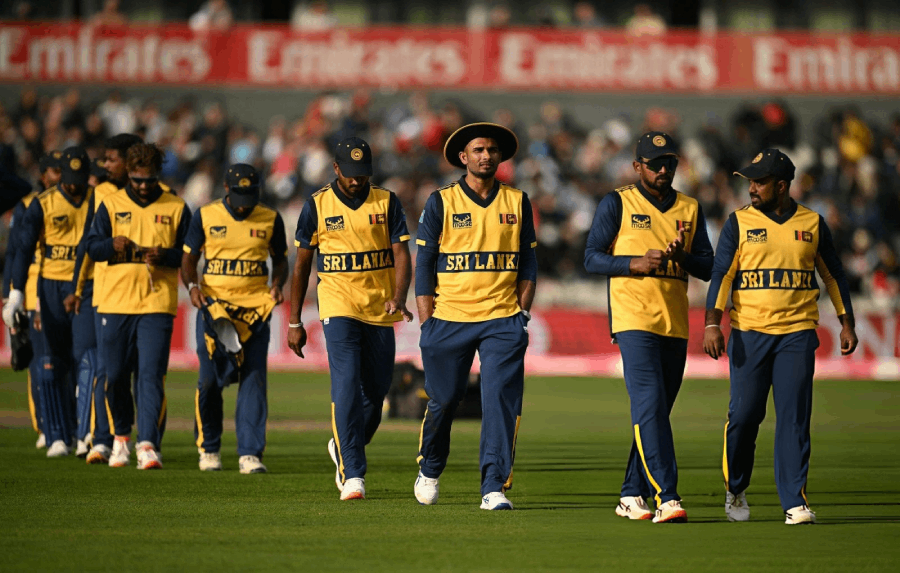
Sri Lanka travelled to England for six white ball games at the tail end of the summer knowing full well that this would be an examination of character. In the T20 format in particular, they were facing an uphill battle.
England are a side with most bases covered in the shortest format, as they showed during the recent T20 World Cup, where they reached the semi-finals before being knocked out by eventual champions India.
Yet few would have expected Sri Lanka to be so comprehensively outplayed. Not only did they suffer a 3-0 drubbing, they finished the series with more questions than answers and precious few positives to take home. Perhaps the most damning statistic was that not a single Sri Lankan batter managed a half century across the three games.
For a start, Sri Lanka appear to have erred in selection. From the outset, there was a feeling that they had packed too many spinners into the squad. The selectors argued that pitches late in the English summer would be dry and offer assistance to spin, but that theory hardly survived contact with reality. Sri Lanka’s bowlers rarely managed to put the brakes on England’s free flowing batsmen.
The shortcomings of the batting unit, however, were far more worrying. Essentially, Sri Lanka have persisted with much the same batting group that failed to deliver at this year’s World Cup. When a formula repeatedly produces the same result, there comes a point when perseverance begins to look suspiciously like stubbornness. Fresh blood is badly needed.
Losing is one thing. Losing without throwing a punch is another. Sri Lanka barely mounted a serious challenge throughout the series. The batsmen struggled to clear the ropes and, when boundaries dried up, they were equally poor at working the ball into gaps, rotating the strike and collecting ones and twos. The mounting number of dot balls repeatedly squeezed the life out of the innings.
None of this is new. These problems have been staring Sri Lankan cricket in the face for some time. What is troubling is that, despite identifying them, the team has been unable to find solutions.
The authorities can hardly be accused of not trying. Power hitting specialists have been brought in. Batting coaches with impressive credentials in the IPL and with the Indian team have been employed. Psychologists have been engaged. Yet the same old ailments keep resurfacing.
The inability to bat out the full quota of 20 overs has been another recurring problem for several years. In modern T20 cricket, where teams are routinely pushing the boundaries of what is possible with the bat, failing even to use 120 deliveries is unforgivable. England merely exposed an old wound rather than creating a new one.
Their clean sweep enabled England to regain the No. 1 ranking in T20 cricket. For Sri Lanka, meanwhile, the series underlined just how far they have fallen behind the leading sides.
That raises an uncomfortable question. How has a proud cricketing nation that once revolutionized white ball cricket and forced the rest of the world to follow its lead ended up struggling to keep pace with the game it once helped redefine?
At present, teams such as England, Australia, India and New Zealand seem to be playing a different brand of T20 cricket. The gap is not merely about hitting more sixes. It is about game awareness, innovation and the ability to adapt under pressure. Sri Lanka have fallen behind in too many of those areas.
These are worrying signs and the authorities need to identify the problems and confront them rather than applying another coat of paint over the cracks. Standards have to be set and more importantly, enforced. Unless certain non negotiables are established, whether in fitness, preparation, selection or performance, there is little reason to believe the slump will correct itself.
Sri Lanka should be more competitive when the ODI series gets underway at Chester-le-Street. The 50 over format is one in which they have made steady progress over the last three years, including notable successes against India and Australia. T20 cricket, though, remains the festering sore.