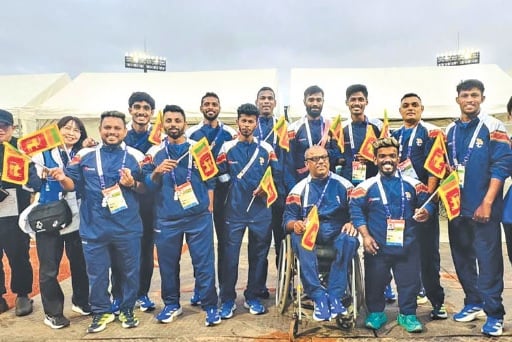
Sri Lanka’s para athletes brought the curtain down on the 5th Asian Para Games in Nagoya, Japan, with a string of stunning performances, securing two gold, four silver and three bronze medals. The nine-medal haul lifted the island nation to 16th place in the overall standings and confirmed its position as the second most successful country in the South Asian region, behind only the subcontinental giant, India. Para athletics accounted for the lion’s share of the medals, with seven, while para swimming secured the remaining two to round off a memorable campaign.
The spotlight in Nagoya belonged to Janani Dhananjana Wikramasinghe and Pradeep Somasiri, who each struck gold with new Games records. Dhananjana, a 21-year-old from Kuliyapitiya in the Kurunegala District, was Sri Lanka’s standout performer at the Games. She opened her campaign with a brilliant silver-medal finish in the women’s T47 200m, clocking 25.80 seconds. She then rose to the top of the podium in the T47 long jump, upgrading the silver she won in the same event at the 2023 Asian Para Games in Hangzhou with a new Games record of 5.52 metres. India’s Nimasha Chakkungalparambil claimed silver with a jump of 5.37 metres, while China’s Jin Chen took bronze with 5.17 metres. Sri Lanka’s Swarnamali Jayasundara finished fourth with a leap of 4.11 metres.
A fine product of the coaching and guidance of veteran coach Nalinda Senerath, Dhananjana narrowly missed out on a rare triple triumph when she finished fourth in the 100m. At just 21, however, she has time very much on her side. Her golden leap in Nagoya confirmed her status as one of the rising stars of Sri Lankan para sport and the heartbeat of the island’s campaign in Japan.
On the track, experienced middle-distance runner Pradeep Somasiri defended his men’s T46 1500m crown in commanding fashion. Coached by veteran Sajith Jayalal, he seized an early lead and maintained his advantage all the way to the finish line, clocking an impressive 4:03.25 to set a new Games record. India’s Promod clinched silver in 4:09.65, while the Philippines’ James Reyes secured bronze in 4:13.81. The triumph carried particular significance for the Sri Lankan athlete. He had won the same title at Hangzhou in 2023 with a Games record of 4:05.14, meaning his Nagoya performance shaved a remarkable 1.89 seconds off his previous mark. He also arrived in Japan with an impressive pedigree, having won bronze at the 2025 World Para Athletics Championships in New Delhi, where his time of 3:53.77 in the same event stands as an Asian record.
>>Sri Lankan Para Athletes clinch three Golds at 3rd Asian Youth Para Games
Sprinter Nuwan Indika produced one of the most bittersweet results of the campaign. The experienced sprinter clocked 11.58 seconds in the men’s T44 100m, recording a season’s best that was also faster than the 11.63 seconds with which he won gold at the 2023 Asian Para Games. Nevertheless, he had to settle for silver as Kazakhstan’s Naif Almasahi stormed to gold with a new Games record of 11.15 seconds. Palitha Bandara, the silver medallist in the discus throw at the recently concluded Commonwealth Games, delivered another piece of silverware on Japanese soil, this time in the shot put.
Sri Lanka’s first medal of the Games had, in fact, arrived early, courtesy of Mohammadu Safran, who cleared 6.55 metres to claim bronze in the men’s T47 long jump. Sprinter Saman Subasinghe later added a podium finish of his own with bronze in the men’s T47 400m, underlining the island’s growing strength across the sprint and jumping events.
For every celebration in Nagoya, there was an equal measure of disappointment. Paralympic silver medallist and world record holder Samitha Dulan narrowly missed a podium finish in the men’s F44 javelin throw, finishing fourth after recording a distance of 64.10 metres. The mark remained well short of his own world record of 67.03 metres, which he continues to hold. Buddhika Indrapala then saw the country’s final athletics medal hope slip away, finishing fourth in the men’s T42 100m in 13.39 seconds. Together with Swarnamali Jayasundara’s fourth-place finish in the women’s long jump, these near misses demonstrated just how fine the margins can be between heartbreak and history at this level.
While athletics did the heavy lifting, Sri Lanka’s swimmers made their own impressive contribution to the medal tally. Galina Basnayake won silver in the women’s S9 400m freestyle with a time of 4:59.58, while Naveed Rasheen claimed bronze in the men’s S9 100m butterfly in 1:03.29, bringing further pride to the island nation. The duo came agonisingly close to additional honours, with each finishing fourth in their respective 100m freestyle events. Galina clocked 1:09.00, while Naveed recorded 58.78 seconds. Naveed was unlucky once more in the men’s S9 400m freestyle, finishing fourth in 4:33.27.
Measured against the previous edition of the Games, the Nagoya campaign tells a story of fine margins in both directions. At the 4th Asian Para Games in Hangzhou, Zhejiang, China, Sri Lanka finished 18th with two gold, five silver and four bronze medals. This time, the country climbed two places in the overall standings, even though its overall medal tally declined slightly.
A contingent of 22 athletes represented Sri Lanka across six sports — athletics, swimming, table tennis, badminton, shooting and wheelchair tennis. However, medals came only from athletics and swimming, with competitors in the other four disciplines returning home without a podium finish. Sri Lanka’s para athletics team manager, Lieutenant Colonel Deepal Herath, a former President of the National Paralympic Committee, said the team had narrowly missed out on two additional medals but was satisfied with the overall performance of the contingent.
The comparison Herath draws is a pointed one. A 156-member contingent managed only a single gold medal at the recent Asian Games, while a 22-member para squad returned from Nagoya with nine medals, including two Games records. For a programme operating with fewer facilities and less experience than its regional rivals, this campaign was never just about the medal count. It was a statement that Sri Lanka’s para athletes are no longer merely chasing the world’s best; they are running, jumping and throwing alongside them.