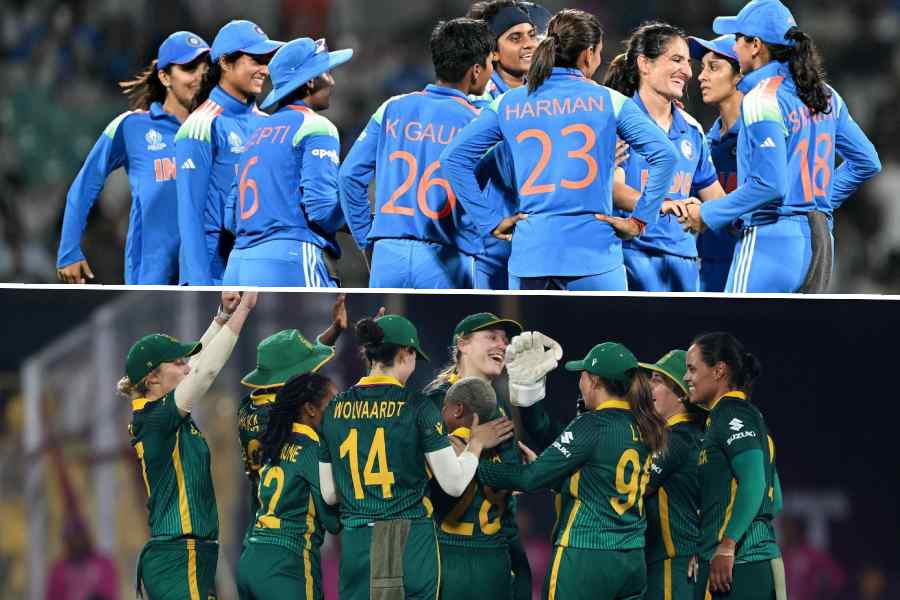
Coming to the tail end of the Women’s World Cup, you felt the tournament had gone by without the usual dose of upsets. World Cups, after all, thrive on those David-versus-Goliath moments — Kenya felling West Indies in 1996, Zimbabwe ambushing Australia in 1983, or Sri Lanka outsmarting India in 1979. The women’s edition made us wait till the final week, but it has delivered in spades. On Sunday night, we will have a new World Champion. Whether India or South Africa lift the trophy, a new dawn awaits women’s cricket.
England and Australia have lorded over the women’s game for as long as anyone can remember. This tournament, too, they finished first and second in the group stage, barely breaking a sweat.
>>Sri Lanka steadier in Asia Cup but flaws linger <<
South Africa and India, meanwhile, had to roll up their sleeves and wade through the hard yards. But such are the glorious uncertainties of cricket that when the chips were down in the knockouts, it was the underdogs who landed the knockout punch. Australia, seven-time champions and England, four-time winners, were both sent packing. The time has come for a fresh name on the silverware.
South Africa’s campaign began on a sour note. They were trounced by England by ten wickets in their opener and later folded for a paltry 97 against Australia. Yet they refused to throw in the towel. India, too, were under the pump after three straight defeats, all from winning positions. Questions swirled about their temperament and ability to close out games. But in the knockout stage, they dusted themselves off and made sure history didn’t repeat itself.
Laura Wolvaardt led from the front in the semi-final, playing an innings for the ages — a sparkling 169 that oozed class and composure. Once the Proteas had 319 on the board, the scoreboard pressure was bound to tell. England fancied their chances with dew and experience on their side, but Marizanne Kapp produced a dream spell with the new ball, ripping out the top order before England could even get off the mark. South Africa, for the first time, had stormed into a World Cup final — and how.
Australia had cruised through the competition as if on autopilot. Four of their batters had posted centuries, some more than once. Their seamers struck early, their spinners squeezed in the middle overs — a well-oiled machine firing on all cylinders. Yet, on the big stage, the wheels suddenly came off. That’s cricket for you — a game that can turn heroes into mere mortals overnight. Ask the West Indies, who took India lightly at Lord’s in 1983 and paid the price.
>>Future of Sri Lankan cricket in safe hands, says Mathews<<
Most Sri Lankans, one suspects, will be rooting for South Africa. There’s a sense that India already has its fingers in too many pies. A victory for the Proteas would remind the cricketing world that the sport is bigger than the so-called Big Three. Given the social and sporting upheavals in South Africa, they richly deserve their moment under the sun.
Their cricket is clearly in good health — runners-up in last year’s Men’s T20 World Cup, winners of the World Test Championship and now finalists in the Women’s showpiece. A triumph here would be the cherry on top — and a windfall for women’s sport across the rainbow nation. But should India prevail, it could alter the game’s global landscape once again. Cast your mind back to 2007. India had been reluctant travellers to the inaugural Men’s T20 World Cup in South Africa, sending a young side while the seniors stayed home. Under M.S. Dhoni’s calm hand, that team went on to lift the trophy, and Indian cricket was never the same again. The IPL was born, players’ fortunes skyrocketed and the cricketing economy was reinvented.
If India’s women emulate that success, brace yourself for a revolution. There will be more opportunities for players, pay scales will soar and women’s cricket will finally claim its seat at the high table. Whatever happens on Sunday, one thing’s for sure — the game will emerge richer. Let the best team win.