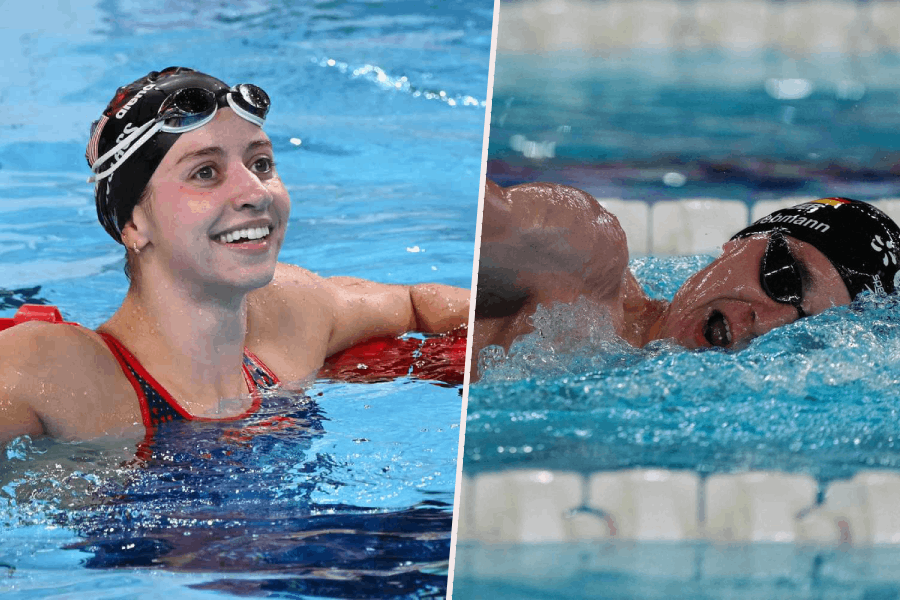
Two extraordinary swims on opposite sides of the world have given swimming two new world records, with Kate Douglass producing a remarkable double in the women’s 50m freestyle and Germany’s Johannes Liebmann breaking the men’s 1500m freestyle record in Paris.
At the 2026 Pan Pacific Championships in Irvine, California, Douglass had already made headlines before the evening final had even begun. The American opened her day by swimming 23.49 seconds in the heats, taking 0.06 seconds off Gretchen Walsh’s world record of 23.55.
Returning for the final less than nine hours later, she produced an even faster performance, touching in 23.19 seconds to take another 0.30 seconds off the record. It was a stunning improvement in an event where the margins at the top level are measured in hundredths of a second.
The swim also marked a significant milestone. Douglass became the first woman to break the 23.5-second barrier in the 50m freestyle, while her 0.55-second advantage over silver medallist Walsh underlined just how dominant the performance was.
To put the improvement into perspective, a three-tenths-of-a-second drop in a 50m world record in a single day is something that has not been seen since 1988.
While Douglass was making history in Irvine, 19-year-old Johannes Liebmann was doing the same in Paris. Competing at the 2026 European Aquatics Championships, the German produced a remarkable 14:26.79 in the men’s 1500m freestyle to win gold and take almost four seconds off the previous world record.
The old mark of 14:30.67 had been set by American Bobby Finke at the Paris 2024 Olympic Games. Liebmann lowered it by 3.88 seconds, becoming the first man to swim under 14 minutes and 30 seconds in the event.
The race was built around an aggressive start. Liebmann immediately put himself in front of the field and then managed to maintain his pace deep into the race, combining the speed of a middle-distance swimmer with the efficiency required to sustain a world-record pace over 1500 metres.
The size of the improvement made the swim even more remarkable. World records in the 1500m are rarely broken by several seconds, particularly at the very top of the sport. Liebmann’s performance therefore stands as one of the most significant improvements the event has seen in years.
Douglass and Liebmann took very different routes to their records. One produced two world-record swims in the space of a day; the other maintained a record-breaking pace for 1500 metres. But both performances had the same result: two benchmarks were replaced by times that will now set the standard for everyone who follows.