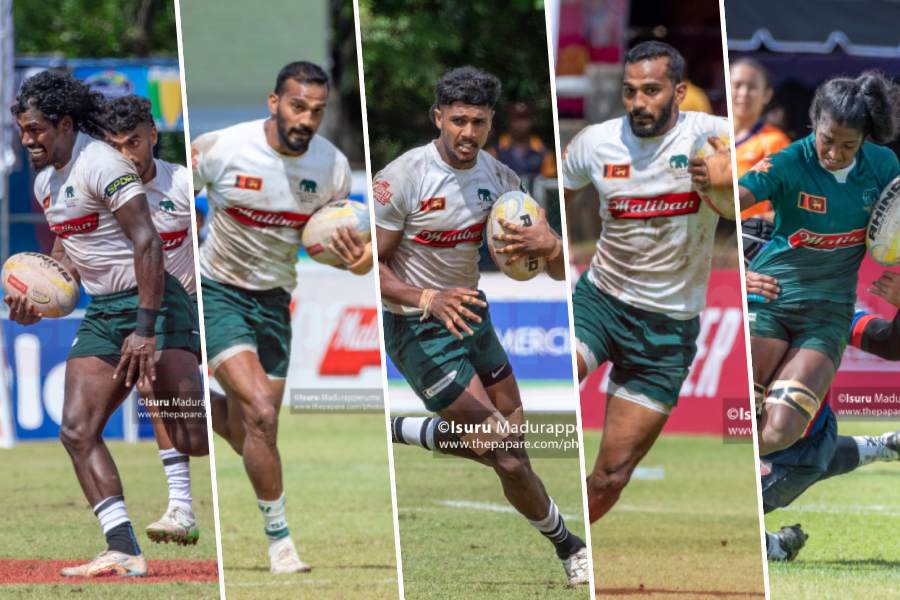
The opening leg of the Asia Rugby Emirates Men’s 7s Series in Suzhou, China, proved to be a tournament of mixed fortunes for the Sri Lankan Tuskers. While the campaign was largely defined by nail-biting losses and frustrating what-ifs, the Sri Lankan Men’s outfit managed to salvage some pride, ending on a high note with a dominant 36-05 victory over Malaysia in the seventh-place playoff Final.
The Sri Lankan Tuskers were drawn into a highly competitive Pool where a few heavy weights were featured.
Pool A: Hong Kong China, Thailand, Malaysia, Uzbekistan
Pool B: Japan, UAE, Singapore, India
Pool C: China, Korea, Sri Lanka, Kazakhstan
Sri Lanka Men’s Squad : Srinath Sooriyabandara (Captain), Akash Madusanka, Chathura Soysa, Diluksha Dange, Shaahid Zumri, Kavindu Perera, Dinal Ekanayake, Gayan Perera, Naveen Marasinghe, Ravindu Anjula, Pasindu Bandara, Jayathu Rajarathne, Peter Woods (Head Coach), Buddika Kulatunge (Rugby Manager)
The Tuskers started their campaign with flying colors, completely dismantling Kazakhstan. Crossing the whitewash four times in the first half, Sri Lanka went into the break leading 28 – 00. They continued their dominance in the second half, adding three more tries to lead 49 – 00 until the final minute, before Kazakhstan snagged a late consolation try to make it 49 – 05.
However, the momentum quickly shifted during their second outing against South Korea. Sri Lanka raced to a 12 – 00 lead, but disaster struck when Skipper Sooriyabandara was forced off the field with an injury. The game’s dynamic instantly changed. Though the Tuskers held a narrow 12 – 07 lead at Half Time, a spirited South Korean side staged a remarkable second-half comeback to edge out Sri Lanka by an agonizing two points, 19 – 17.
The final pool fixture against a formidable Chinese side was a do-or-die encounter. After a toe-to-toe first half, the teams went into the break locked at 12 – 12. As the game wore on, the hosts appeared far more settled, executing fine 7s Rugby in the closing minutes to snatch a 26 – 17 victory.
Despite finishing third in Pool C, Sri Lanka’s thumping win over Kazakhstan and narrow margin of defeats were enough to see them squeeze into the Cup Quarter Finals. There, they faced continental heavyweights Japan. For the first half, the Lankan Tuskers put up a masterclass in defensive work, frustrating the champions and keeping the score at 00 – 00. However, Japan’s class eventually emerged as they regrouped in the second half to cruise to a 17 – 00 victory, shattering Sri Lanka’s Cup title hopes.
Relegated to the Plate Semi Finals, Sri Lanka faced Thailand. Given previous results, the Tuskers were favored to win, but an improved and ferocious Thai side had other plans. Thailand held a commanding 17 – 07 lead at the half. Sri Lanka mounted a valiant comeback attempt in the latter stages, but the Thai defense remained unshaken, securing a 29 – 19 upset.
With the Plate Semi Final defeat, Sri Lanka was left to fight for the seventh spot against a familiar foe, Malaysia. Finally playing with the freedom and fluency that had eluded them earlier in the weekend, the Tuskers secured a 17 – 00 Half Time lead and never looked back, comfortably posting a 36 – 05 victory. While the performance was splendid, it ultimately felt like too little, too late for a side that had shown flashes of brilliance but struggled to close out games.
A critical evaluation of Sri Lanka’s strategy reveals areas needing urgent rectification. A number of missed tackles cost the team dearly at crucial junctures. Furthermore, the Tuskers’ game plan came under scrutiny. In modern Rugby Sevens, working the ball from touchline to touchline is a core attacking strategy used to stretch the defense, create numerical overlaps, and exploit gaps. However, Sri Lanka frequently resorted to body-contact rugby, taking heavy players head-on rather than utilizing width, a tactical misstep that stalled their attacking potency throughout the tournament.
Elsewhere in the Men’s competition, Hong Kong China displayed sheer dominance. After steamrolling South Korea 26 – 00 in the Semi Finals and watching Japan comprehensively defeat China 36 – 05, Hong Kong secured the Cup title with a commanding 19 – 07 victory over Japan in the Final.
It was a similarly tough weekend for the Sri Lanka Women’s side, captained by Charani Liyanage. placed in a difficult group, the Lankan lasses suffered heavy defeats at the hands of Thailand (57 – 00) and Hong Kong (47 – 00). They managed to secure a 10 – 00 victory against Malaysia in their final pool game, but it was insufficient to secure a Quarter Final berth.
Forced into the 9th-place playoff bracket, the Women’s team suffered a shocking 17 – 10 reversal against Malaysia on the second day. Their woes continued as Singapore edged them out 15 – 10, while their final match against Iran was cancelled due to adverse weather. Ultimately, Sri Lanka avoided the wooden spoon by virtue of point differential, finishing in 11th place out of 12 teams. The Women’s Cup title was clinched by the Japanese side after comprehensively defeating (24 – 07) Chinese ladies.
With the dust settling in Suzhou, both the Men’s and Women’s teams will have to regroup quickly. The second and final leg of the Asia Rugby Emirates 7s Series is scheduled to take place on home soil in Colombo, Sri Lanka, on October 17 – 18. The tournament will not only be a chance for redemption, but will also serve as the stage where the 2026 series champions will be crowned. For the Tuskers, a tactical rethink and tightening up on defense will be paramount if they are to thrill their home crowd.