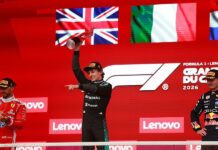
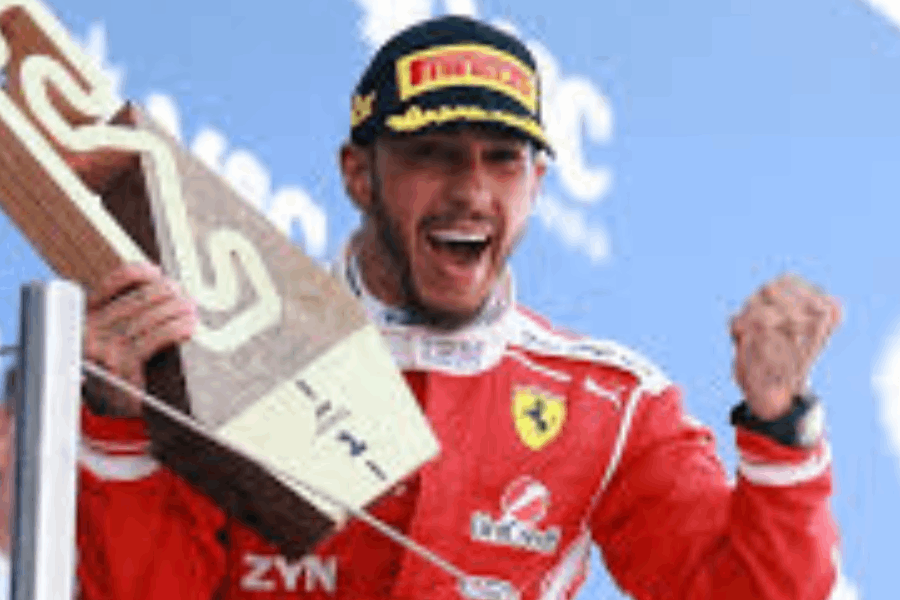
Lewis Hamilton claimed his first-ever win for Ferrari, securing a record seventh victory in Barcelona to become the outright record holder for the most wins at the circuit, surpassing fellow seven-time world champion Michael Schumacher. The 41-year-old also became the oldest driver to win a Grand Prix since 1970, when Sir Jack Brabham won at age 43. This historic victory broke a long winless streak for both Hamilton and Ferrari; Hamilton’s last victory came in Belgium in 2024, while Ferrari’s last triumph was in Mexico in 2024 with current Williams driver Carlos Sainz. George Russell, who started on pole, finished P2 after his teammate and championship leader Kimi Antonelli was forced to retire due to an engine problem in the dying laps. Lando Norris claimed the remaining podium spot to make it an all-British podium for the first time since October 1968, when Sir Jackie Stewart, Graham Hill, and John Surtees stood on the rostrum at the US Grand Prix. With the circuit being brutal on the tyres, multiple pit stops were required, and team strategies played a massive role throughout a race that marked the first time this season Mercedes did not emerge victorious.
Practice and Qualifying
Friday’s first practice session saw many teams, including Mercedes, Ferrari, McLaren, and Red Bull, fielding a rookie driver under the mandatory Formula 1 rule, which requires every team to run a rookie—someone who has started two or fewer Grands Prix—in at least four FP1 sessions throughout the season. George Russell topped FP1, with Oscar Piastri and Charles Leclerc following in second and third, respectively. Lando Norris topped FP2, showing real promise for McLaren heading into Saturday, while his teammate Piastri finished third. However, Russell managed to return to the top of the timing sheets in FP3, sending a clear message to his teammate that he would not yield without a fight. McLaren continued to show strong pace with Piastri finishing second, while Ferrari’s Leclerc finished third. Hamilton initially struggled with the new upgrades during this practice session, finishing fifth and half a second slower than his teammate.
Hamilton showed his first real signs of promise for the weekend during Q1, topping the standings and going faster than both Mercedes cars. Aston Martin and Cadillac continued their difficult form, exiting in Q1 alongside Williams’ Alex Albon and Haas’s Esteban Ocon. Significantly, Lance Stroll managed to outqualify his teammate and home hero Fernando Alonso, ending a 42-race qualifying streak. Q2 concluded with the two Alpines, the remaining Haas and Williams cars, Audi’s Gabriel Bortoleto, and Racing Bulls’ Arvid Lindblad being eliminated. Nico Hulkenberg managed to secure his first Q3 appearance of the season after logging multiple P11 finishes prior. Q3 was red-flagged a few minutes into the session after Leclerc crashed during his flying lap, continuing his string of bad luck from Monaco and relegating him to P10 on the grid. Oscar Piastri, who had completed a lap before the crash, held provisional pole until Russell posted a faster time on his first run using a used tyre. During the final runs, Kimi Antonelli initially set a faster lap, but it was instantly bettered by his teammate. Russell’s pole position was confirmed when Hamilton’s final flying lap fell short by just six-hundredths of a second. Hamilton qualified P2, sandwiched between the two Mercedes, with Antonelli in P3. Norris finished fourth-fastest, while the Red Bull duo of Max Verstappen and Isack Hadjar finished fifth and sixth, respectively. Piastri only managed the seventh-fastest time, a disappointing result for McLaren after failing to capitalize on their practice pace. Liam Lawson secured P8, and Hulkenberg lined up P9 on the grid.
Race Dynamics
With high tyre degradation dictating a minimum two-stop strategy, the frontrunners’ tyre choices became a major talking point heading into the race. Every weekend, Pirelli—the official tyre supplier for Formula 1—allocates a strict number of tyre sets that teams must carefully manage across all sessions. Consequently, drivers who advance deep into qualifying often find themselves with fewer fresh sets available for the Grand Prix, adding an intriguing layer of strategic variance. While the rest of the leading pack opted to start on fresh Medium compounds, Lewis Hamilton and Max Verstappen rolled the dice on used Softs. The two veterans were banking on a lightning-fast getaway off the line or the potential of an early Safety Car—a distinct possibility at the Circuit de Barcelona-Catalunya. After all, the track is no stranger to opening-lap drama, with this race marking exactly ten years since the infamous Lap 1 collision between then-teammates Hamilton and Nico Rosberg.
Contrary to what history suggested, the race started with minimal drama among the frontrunners, as George Russell led off the line with Hamilton and Antonelli following closely behind. Isack Hadjar suffered a terrible start, tumbling down the order to P14, while Charles Leclerc managed to execute several overtakes, climbing from P10 to P7. Leclerc subsequently overtook Piastri on Lap 8, advancing to P6. Hadjar eventually put his poor start behind him, recovering through the field to reclaim P8 by Lap 21.
Lewis Hamilton initiated the pit stop sequence on Lap 11, switching to fresh Hards. This forced Russell into the pits on the following lap to protect against the undercut, which was particularly powerful due to the high tyre degradation. Hamilton then came into the pits for a second time on Lap 27, taking on a new set of Mediums. The two Mercedes drivers did not react immediately, waiting another 10 laps before making their second stops. During this crucial stint, Hamilton managed to lap almost two seconds faster than his rivals, erasing a 20-second deficit. When Russell finally pitted, Hamilton inherited the lead with a comfortable 17-second advantage.
On Lap 40, Fernando Alonso’s race came to a premature end due to an engine failure, triggering a Virtual Safety Car (VSC). This played perfectly into the hands of Lewis Hamilton and Ferrari. Capitalising on the reduced track speeds, the Scuderia executed a ‘cheap’ pit stop—losing significantly less time to the rest of the field than under normal racing conditions—and bolted on Hamilton’s final set of Hard tyres. He emerged from the pit lane just ahead of George Russell at the exact moment the VSC period ended. Perfectly positioned in clean air and armed with fresher rubber, Hamilton drove with absolute swagger. He consistently outpaced the rest of the pack, extending his advantage to a commanding 20-second lead by the chequered flag. It was a deeply historic triumph: his 106th Formula 1 victory, his seventh in Barcelona, and crucially, his first-ever win for Ferrari—fulfilling the ultimate dream of almost every driver who graces the pinnacle of motorsport.
Behind him, an intra-team battle was raging between Antonelli and Russell for P2. Antonelli initially got the better of his teammate, executing a clean overtake with only five laps remaining. However, mirroring Russell’s heartbreak in Canada, Antonelli soon came to a disappointing halt due to a sudden engine failure. This promoted Russell back to P2 and elevated Lando Norris to P3. Charles Leclerc, who was running in P6 and applying pressure to Max Verstappen ahead, saw his terrible luck continue; a power steering issue forced him to retire his Ferrari. Nico Hulkenberg, running a strong race in P10 behind Liam Lawson, suffered a bizarre stroke of bad luck. A rogue piece of gravel kicked up by Lawson going wide at Turn 12 struck the emergency safety trigger (kill switch) on the left side of the Audi’s roll hoop. This one-in-a-million shot forced a heartbroken Hulkenberg to retire from an otherwise stellar weekend.
Max Verstappen, who endured a relatively uneventful weekend, finished P4, followed by Oscar Piastri in P5. Isack Hadjar’s impressive recovery drive earned him P6. Pierre Gasly climbed from P14 on the grid to finish P7, making him the only driver other than Hamilton to score points in every race so far this season. Despite crossing the line in P8, his teammate Franco Colapinto was demoted to P10 after receiving a 10-second post-race penalty for failing to slow under yellow flags. As a result, Racing Bulls drivers Liam Lawson and Arvid Lindblad were promoted to P8 and P9, respectively.
Looking Ahead
As the Formula 1 paddock heads into the upcoming Austria and Silverstone double-header, the championship dynamics are beginning to shift. Ferrari’s latest upgrade package has proven effective, giving Lewis Hamilton the pace to secure a historic win and showing the team can manage high-degradation races. At the same time, Red Bull is rumoured to be introducing a significant update at their home race in Spielberg in an effort to close the performance gap. With Mercedes experiencing recent engine reliability issues that have cost both Kimi Antonelli and George Russell valuable points, the title fight is starting to look much more competitive. It will be interesting to see how this ongoing development race impacts the championship standings over the next few European rounds.
Do stay tuned to Sri Lanka’s No. 1 Sports channel, ThePapare, to catch all the sports news all around the globe.