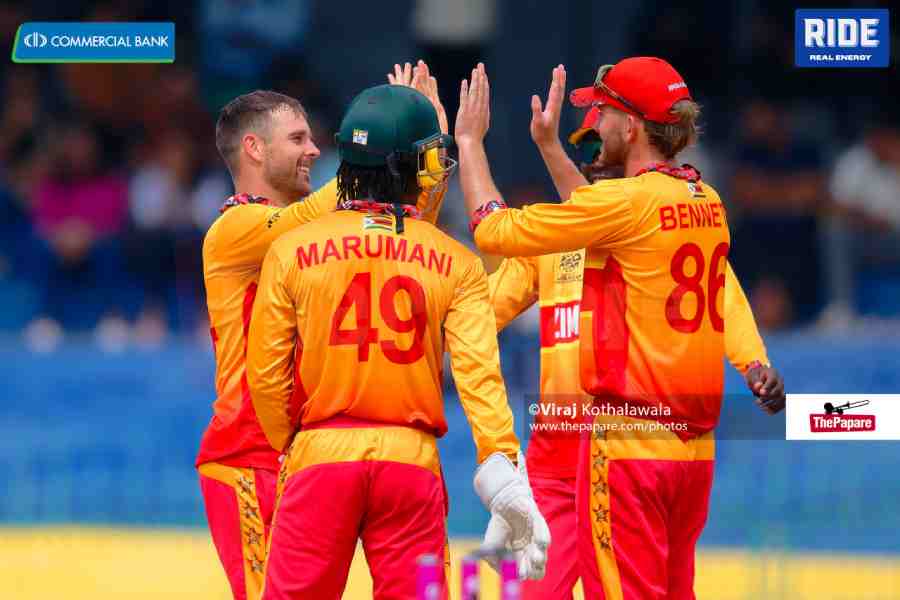
The T20 World Cup served up its first proper ambush when former champions Australia were toppled by Zimbabwe, the world’s No. 2 side brought to its knees by a team ranked 11th. On paper it was a mismatch. But RPS tend to punish teams that aren’t ready to put in the hard yards.
Cricket, as the cliché goes, is not played on paper. It is played on a 22-yard strip that can humble reputations and expose bravado. At Colombo’s R. Premadasa Stadium, it is not muscle that wins matches but method. Zimbabwe read the script. Australia tried to rewrite it and paid the price.
>>Four Tests a year leaves Sri Lanka on a sticky wicket<<
The warning signs were there. In the last four years, Australia had suffered two bilateral series defeats at RPS, undone by spin. Yet the homework appeared half done.
T20 cricket may be packaged as a festival of flair and Australia have it in abundance. But RPS is no runway for flat-track bullies. It is a surface where the ball holds up, mishits plug into the deep and cross-batted swipes often end in a skier or a drag-on. Keep swinging for the hills and sooner rather than later you hole out, as Glenn Maxwell discovered.
Maxwell remains one of the game’s most explosive finishers, box-office on true pitches where the ball comes sweetly onto the bat. But on tracks that demand soft hands, sharp cricketing nous and a cool head, he has too often been found wanting. He was not alone. Several Australian batters perished chasing glory shots when graft was the order of the day.
In contrast, Zimbabwe opener Brian Bennett offered a masterclass in application. He batted through the innings as though he had grown up on these surfaces, milking singles, piercing gaps, hustling between the wickets and crucially, keeping the ball on the carpet. There were no agricultural heaves, no ego-driven launches into the night sky.
Modern batters, once past fifty with wickets in hand, tend to throw the kitchen sink in the closing overs. Bennett resisted the temptation. It was as if he had a par score etched in his mind and was batting to that number. Once Zimbabwe posted 170, the contest was alive. At RPS, that is often more than enough.
Therein lies the blueprint. Application is the currency at RPS, audacity without calculation is a fast track to the pavilion.
Friday’s result has blown Group ‘B’ wide open. Australia and Sri Lanka began as front-runners, but the script has been smudged. Australia are out if they lose to Sri Lanka on Monday. Yet the hosts themselves are not out of the woods. If they fail to overcome Australia, even victory over Zimbabwe may not guarantee safe passage. Net Run Rate lurks in the shadows, and in this format the margins are wafer-thin.
>>Future of Sri Lankan cricket in safe hands, says Mathews<<
Sri Lanka, though, will not face Australia at RPS. Monday’s contest is in Pallekele, arguably the truest batting surface in the country, with due respect to the SSC. It is a venue where their stroke makers can breathe easier.
There has also been a whiff of overconfidence about Australia’s campaign management. They delayed naming a replacement for the injured Josh Hazlewood, seemingly assuming they could cruise through the group stage before fine-tuning their squad for the knockouts. It was a gamble that smacked of looking too far down the road.
In cricket, as in life, tomorrow is promised to no one. As Lord Buddha taught, the present moment is all we truly possess.