The Asia Rugby Emirates U18 Sevens 2026 concluded in Qingdao with a mixed bag of results for the Sri Lankan outfits. While the Junior Tuskers regrouped after a lacklustre opening day to secure the Boys’ Plate Championship, the girls’ team faced a steeper challenge, ultimately finishing in seventh place after defeating Kazakhstan in their final playoff.
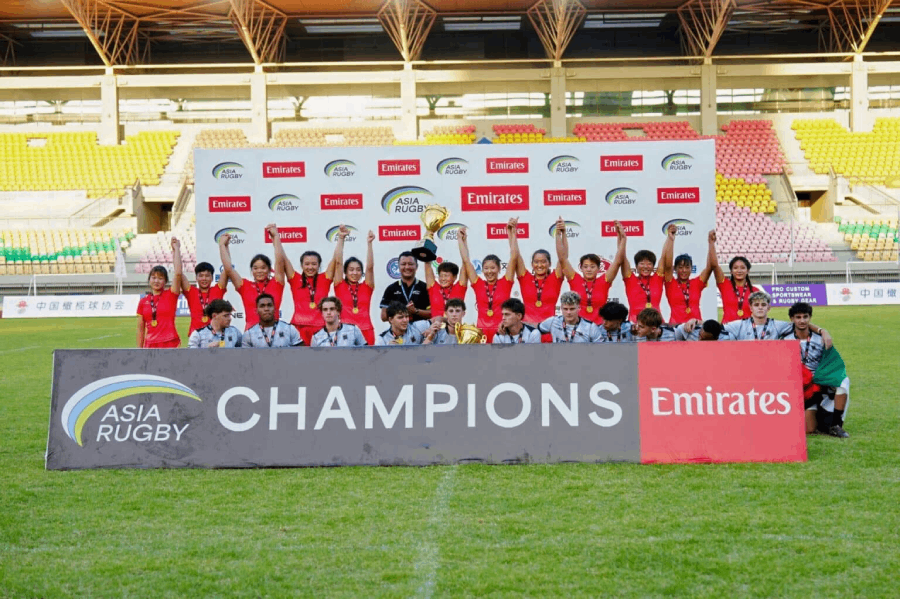
The tournament was dominated by the hosts and the United Arab Emirates, with China retaining the girls’ title and the UAE securing the boys’ Cup Championship. Both sides remained unbeaten throughout the campaign.
The Junior Tuskers, coached by Rajeev Perera and led by Wesley College’s Muhammed Fawaz, travelled to China with high aspirations of a podium finish. However, the opening day proved to be a reality check against the region’s heavyweights.
>>Sri Lanka Selects Star-Studded Squads for Asia Rugby Emirates U18 7s<<
In their first pool fixture, Sri Lanka faced a formidable Hong Kong China side. Hong Kong China got off to a blistering start, crossing the try line three times in the first half. They continued their dominance after the break with another try. Although the Junior Tuskers began to settle as the game progressed, skipper Fawaz exploited a gap to run in a try under the posts. Hong Kong, however, held their nerve to secure a 24–07 victory.
Things did not get any easier in the second pool game against Malaysia. The Malaysian brigade astonished the Lankan defence with their agility and pace, running in three tries in the first half. Fawaz managed to pierce the defence for Sri Lanka’s first try, but Malaysia added another after the break to secure a comfortable 22–07 victory.
In their final pool game, Sri Lanka faced neighbouring India. Expected to be a walk in the park, the match instead saw a spirited Indian side put up a brave fight. At the brink of half-time, a quick tap penalty on the five-metre line allowed Sri Lanka to take a 07–00 lead into the break. They added one more try in the second half to win 12–00, but the victory was insufficient to propel them into the Cup title fray.
Determined to salvage their campaign, the Junior Tuskers entered the Plate segment with renewed strength. In the Plate semi-final against Uzbekistan, Sri Lanka found their rhythm, securing a convincing 19–07 victory to book their place in the final.
The Plate final saw a rematch against India. This time, the Tuskers delivered a vastly improved performance, getting off to a flying start. By half-time, Sri Lanka led 22–00. The team moved the ball quickly and recycled possession effectively, a strategy that paid dividends as they sealed the championship with a commanding 34–07 victory to end their campaign on a high.
The girls’ outfit, guided by coach Shamly Nawaz, faced a tough draw in the group stages. They began with a heavy 71–00 defeat at the hands of the hosts, China. They showed resilience in their second game against Kazakhstan, holding on until the final second with the score tied at 12–
12. However, a last-gasp try from Kazakhstan broke the hearts of the Lankan lasses, resulting in a narrow defeat. The pool stages ended with a 25–05 loss to Uzbekistan.
On the second day, Sri Lanka faced a strong Indian side in the Plate semi-finals. India replied with a barrage of tries, securing a 41–00 victory to advance to the final.
Relegated to the seventh-place playoff, Sri Lanka faced Kazakhstan once again. In a tightly contested affair, the Lankan girls edged out their opponents, securing a 12–07 victory to finish the tournament on a positive, if challenging, note.
In the premier Cup finals, the UAE boys dictated terms against Hong Kong China, winning 26–00 to secure the title. In the girls’ championship, the hosts China overpowered Hong Kong China 34–05 to retain their crown.
Overall, the tournament will be viewed as a disappointment for Sri Lanka, particularly for the boys’ team, which finished third in the previous year. The drop in the standings is a major blow for the islanders.
There appears to have been no issue with selection, as the authorities meticulously picked top talents who had excelled in domestic tournaments. However, the results highlighted a growing gap in the region. Other nations have adapted to the rapidly evolving game of rugby, modernising their strategies and structures in comparison to Sri Lanka.
These shortcomings should serve as an eye-opener for the authorities. To compete with the Asian heavyweights, Sri Lanka must modernise its approach, embrace current trends and technology, and make the necessary structural changes to bridge the growing gap