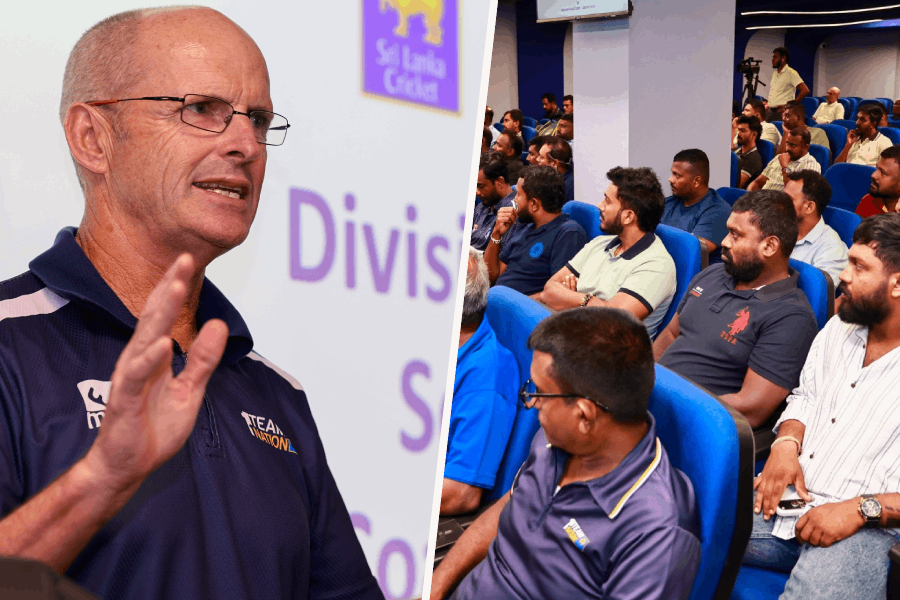
Sri Lanka Cricket has addressed one of the burning issues facing the game by turning its attention to the standards of coaching in school cricket. In a bid to raise those standards, more than 70 coaches involved in Division I and Division II cricket were brought to the High Performance Centre, where national team Head Coach Gary Kirsten shared valuable insights into modern day coaching methods.
This is only the beginning of what promises to be a long-term effort to improve coaching standards. There will be many more specialized sessions conducted by experts in various fields.
What SLC is attempting to achieve is far broader than simply improving technical aspects of the game. The focus is also on the mental side of cricket, helping youngsters develop both as players and as individuals. Other areas such as nutrition, conduct, injury management and overall wellbeing will also be addressed. For this initiative, SLC deserves commendation, particularly the Cricket Committee headed by Sidath Wettimuny, which has been driving the process.
These coaching clinics are expected to take place once a month, with the objective of raising standards among coaches at grassroots level and creating a more professional environment for the next generation of cricketers.
There was a time when cricket was confined to a handful of schools in Colombo and a few leading outstation institutions. But after the World Cup triumph in 1996, interest in the sport went through the roof and the number of schools playing cricket mushroomed. Sadly, the standard of coaching did not keep pace with that rapid expansion and remained an issue that was rarely addressed.
Coaches themselves are under immense pressure from old boys’ associations and school administrations, many of whom are obsessed with results. Consequently, some have adopted win at all costs strategies that do little to develop players for the future. In other cases, there are coaches who place such a premium on avoiding defeat that securing a draw becomes the primary objective, with victory pursued only when success is virtually guaranteed. Gone are the days when captains made bold declarations in pursuit of outright wins.
Another disappointing phenomenon in school cricket is that even at Under-13 level, coaches are constantly passing instructions from the boundary rope after virtually every ball. Coaches have effectively become autopilots running the game from outside the field, leaving captains little more than messengers. As a result, young leaders are denied the opportunity to think creatively, set up batsmen, take calculated risks and learn the art of leadership. They simply execute orders relayed from the boundary. This is an area that urgently requires attention.
The other issue SLC needs to tackle is the mushrooming of cricket academies across the island. While many of these academies play a valuable role in developing players, several others require urgent scrutiny. This is not a new concern. SLC promised to address the issue as far back as 2017 and it now appears they are finally prepared to take the matter head on.
There was a time when players walked out of the school system and straight into the Sri Lankan team. Some even played Test cricket while still wearing school uniforms. That is hardly the case anymore. School cricket’s contribution to Under-19 World Cups has diminished considerably and if the authorities address the shortcomings in the current system, Sri Lanka should at least be capable of becoming a force again at Under-19 level.
Another aspect that warrants attention is the manner in which successful school coaches are absorbed into the SLC structure. When a coach makes a significant impact at school level, the expectation is that he will be entrusted with nurturing the country’s best young talent. Instead, many are diverted to women’s cricket, development squads, ‘A’ teams or various administrative roles. While those positions are important, they do not necessarily maximize the coach’s expertise in youth development. If the objective is to strengthen the pathway from school cricket to the national team, the best coaches should be entrusted with the country’s most promising young cricketers.
The initiative launched this week is certainly a step in the right direction.