
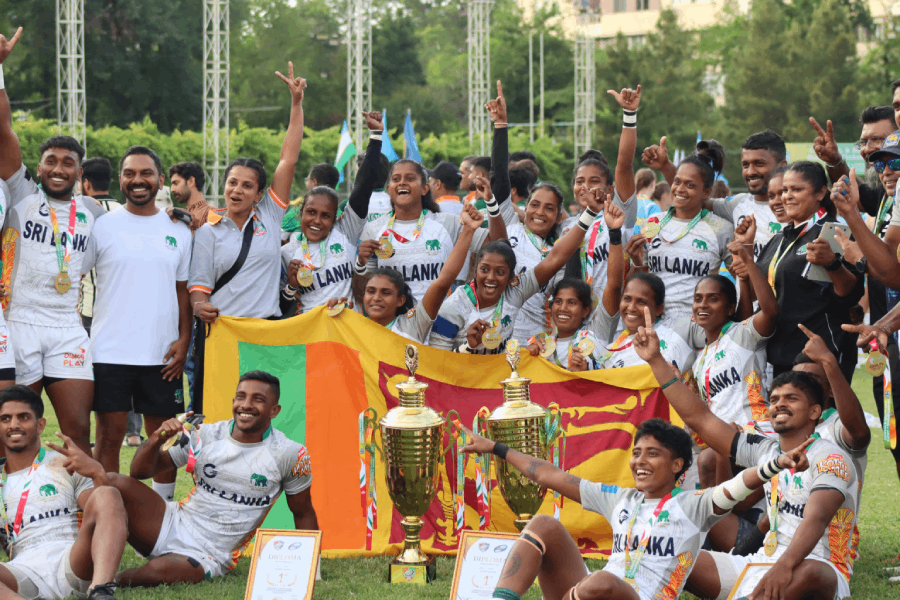
In a powerful declaration of their rising stature in the sport, Sri Lanka has emerged as the undisputed king of rugby in the Central and South Asia region. The island nation made history at the inaugural Central Asia and South Asia (CASA) Rugby 7’s Tournament, held in Tashkent, at the Central Sports Complex of the Ministry of Defence of the Republic of Uzbekistan, by sweeping the board and securing a rare twin crown.
The competition was organised within the framework of the Central and South Asia Rugby Alliance (“CASA”) and was officially supported by Asia Rugby and World Rugby. A total of 12 teams, comprising 6 men’s teams and 6 women’s teams, competed for glory during this vibrant tournament.
Men’s – Sri Lanka, India, Uzbekistan, Pakistan, Mongolia, Kyrgyzstan
Women’s – Sri Lanka, Kazakhstan, Uzbekistan, India, Mongolia, Kyrgyzstan
Over the course of an electrifying weekend, both the Sri Lankan men’s and women’s national rugby 7’s outfits dictated the flow of the tournament with dazzling performances. By dominating their respective finals, Sri Lanka sent a resounding message to the rugby world: the nation is a giant in the making, possessing a depth of talent that is ready to take on the best in Asia.
The Sri Lankan men’s side entered the tournament with a point to prove, and they did so with flair and physicality. Playing under the veteran leadership of Kandy SC star Srinath Sooriyabandara, the team displayed a maturity and tactical awareness that overwhelmed their opponents. During the first outing they massacred the young Kyrgyzstan outfit with a massive 54 – 05 victory. They continued their good rhythm in the next couple of games by comfortably beating Mongolia (43 – 05) and Pakistan (41 – 00). During the second day, Sri Lanka men’s outfit had some tough outings, but the gritty Tuskers absorbed the pressure well and came back stronger to beat Uzbekistan (29 -05) and India (33 – 12) by securing the top spot in the league by keeping their unbeaten tag intact.
The final was a showcase of Sri Lanka’s attacking prowess and defensive solidity as the Tuskers met with the neighbouring giants from India. From the first whistle, India made a strong statement that they came to secure nothing less than the championship and scored the opening try against the rock-solid defence of the Lankans. But Sooriyabandara’s men recovered well and took control of the game, dictating the pace and exploiting gaps in the opposition’s defence. The Tuskers led 14-5 at halftime after scoring two converted tries and continued their attacking game plan even after the lemons. The scoreboard reflected their dominance, as they sealed the title with a comprehensive 33-12 victory. The win not only secured the gold but also underscored the cohesive unit the men’s team have become, blending youthful exuberance with the experience of their captain.
If the men’s victory was impressive, the women’s performance was nothing short of scintillating. Led by Army SC player Charani Liyanage, the Lankan lasses were equally up to the task, showcasing the rapidly growing standard of women’s rugby in the country. During the opening encounter they had a tough challenge against the well-experienced and gritty Kazakhstan outfit. But Lankan lasses held their nerve and posted a thrilling 12 – 05 victory by raising their title hope. In the second game, they demolished the young Kyrgyzstan outfit with a massive 77 – 00 victory. It was followed by another dominant performance to beat Mongolia with a 34 – 00 margin. Though Sri Lankan ladies had an excellent opening day, they faced a tough challenge on the following day. The hosts, Uzbekistan ladies, displayed a stunning performance, but the local girls managed to pull off a draw. During the final encounter against India, Sri Lanka Women suffered a shocking defeat against an underrated Indian outfit. Nevertheless, ladies from the Lion nation secured their place in the final, thankful for their dominant performance showcased on the opening day.
The women’s final saw Sri Lanka face a formidable Kazakh side, but the physical and tactical gap was evident from the outset. Kazakh ladies looked more physical than the locals, but local ladies were electrified with their pure speed, which was definitely decisive in the shooter form of the game. The Sri Lankan brigade assaulted their opponents with relentless pressure and precise handling. The defence was impenetrable and the attack was clinical, leaving the Kazakh women with no answers.
In a commanding display of superiority, Charani Liyanage’s side posted a 27-00 victory to clinch the title. The shutout win was a testament to the team’s discipline and defensive organisation, proving that they are a force to be reckoned with on the international stage.
Sri Lanka’s rising talent, from Isipathana College and current Police SC player Ramith Himasha De Silva, was awarded the player of the tournament title in the men’s segment, while India’s Mahak Chauhan secured the same honours in the women’s competition.
This double victory in Tashkent is more than just two trophies in the cabinet; it is a strong statement regarding the trajectory of rugby in Sri Lanka, especially in the shorter format. By conquering the inaugural CASA tournament, Sri Lanka has laid down a marker for regional supremacy.
The performances in Uzbekistan underscore the success of the domestic club structures, with players from renowned clubs taking the lead. As the nation celebrates this rare twin crown, the focus will now shift to maintaining this momentum. For now, however, the Sri Lankan Lions can bask in the glory of a job well done, having firmly established themselves as the giants of the Central and South Asian regions.
Sri Lanka Men’s League Stage Results
Sri Lanka 54 – 05 Kyrgyzstan
Sri Lanka 43 – 05 Mongolia
Sri Lanka 41 – 00 Pakistan
Sri Lanka 29 – 05 Uzbekistan
Sri Lanka 33 – 12 India
Sri Lanka Women’s League Stage Results
Sri Lanka 12 – 05 Kazakhstan
Sri Lanka 77 – 00 Kyrgyzstan
Sri Lanka 34 – 00 Mongolia
Sri Lanka 12 – 12 Uzbekistan
Sri Lanka 19 – 22 India
Final Standings
Men’s
1st place — Sri Lanka
2nd place — India
3rd place — Uzbekistan
4th place — Pakistan
5th place — Mongolia
6th place — Kyrgyzstan
Women’s
1st place — Sri Lanka
2nd place — Kazakhstan
3rd place — Uzbekistan
4th place — India
5th place — Mongolia
6th place — Kyrgyzstan













 Rugby 7’s Tournament, held in Tashkent, at the Central Sports Complex of the Ministry of Defence of the Republic of Uzbekistan, by sweeping the board and securing a rare twin crown.)